Impact mode
For publishers of reusable workflows and actions — check that the release impact a pull request declares covers what its changes require, so consumers never get a breaking change as a patch.
Impact mode fails a pull request that declares a smaller release than its changes need, such as a fix: title on a
change that renames a job or removes an output of a published reusable workflow.
It grades every change callers can see as major, minor, patch or none, and compares that with the declared impact:
by default the pull request's Conventional Commits title, which release tools such as release-please read from the
squash commit. In the GitHub Action, turn it on with impact: auto (setup).
Callers pin a tag such as @v1 and take every release in it. Rename a job, and their branch protection waits forever
for the old check name (Expected — Waiting for status to be reported), while nothing fails in your repository.
flowpact impact --base origin/main --title "fix: tidy the test job"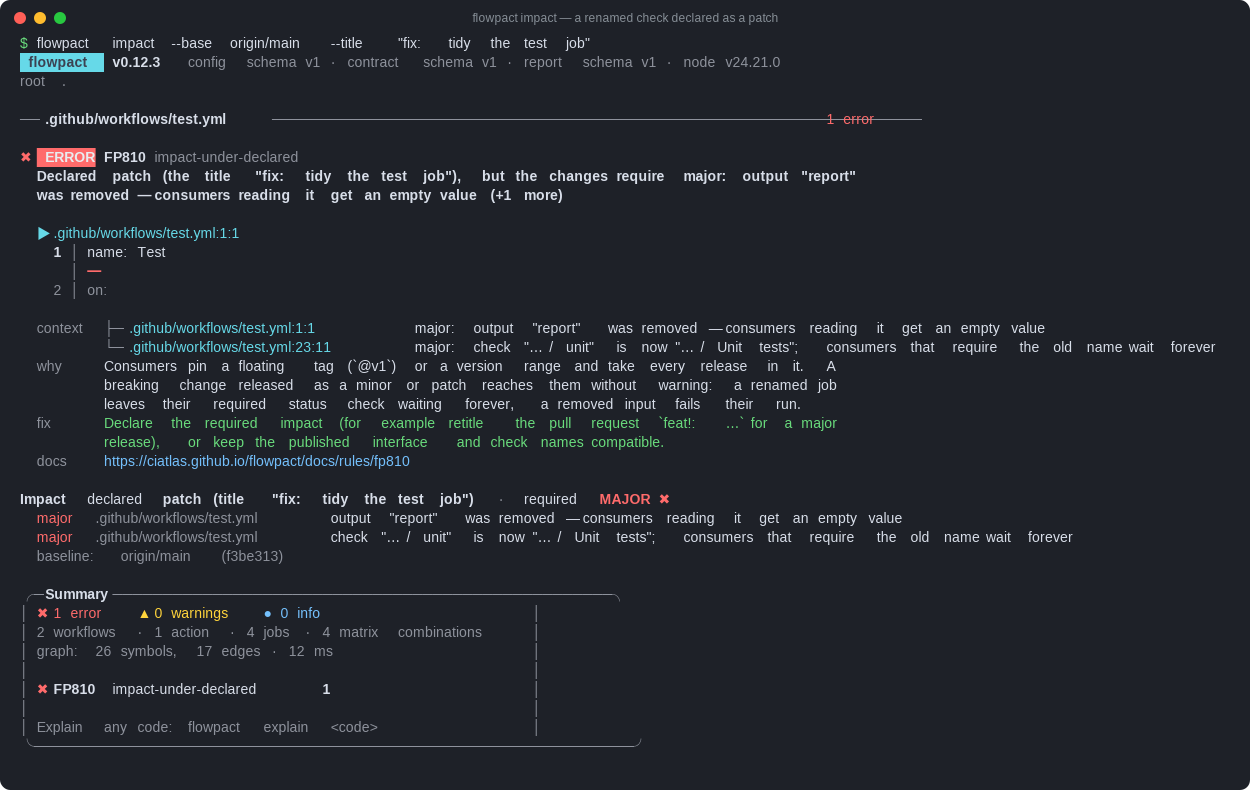
What is graded
Only published units, the ones other repositories call:
- every reusable workflow (
on: workflow_call), except files whose name starts with_(_build.yml), the convention for internal ones; - the action at the repository's root (
action.yml, whatuses: owner/repo@refruns); - or, instead, what
impact.publishlists, such as*/action.ymlin a repository of several actions (**/action.ymlincludes the root one).
Your own CI workflows and .github/actions/** are not graded. An internal workflow counts where a published one calls
it, since its check names appear under the caller's.
| Change to a published unit | Required impact |
|---|---|
A check name is gone: a job renamed or removed, its id changed when it has no name, a matrix key or value changed or removed, ${{ }} added to or removed from name, a nested call removed | major |
| Job id renamed, check name unchanged | none |
| A new check name (a new job or matrix value) | minor |
workflow_call input or secret removed, made required or added as required, input type changed, choice option removed | major |
Output removed (callers read '') | major |
An artifact uploaded with actions/upload-artifact, by the unit or by what it runs, is no longer uploaded under that name: a caller's job that downloads it fails | major (uncertain when the name is chosen at run time) |
An output set on every run is now set only when an if: that reads a context holds: callers read '' otherwise | major, uncertain (FP814) |
| Optional input, secret or output added | minor |
| Input default changed | minor |
Reusable workflow or action moved or deleted, or workflow_call removed | major |
| A published unit no longer parses | major |
A job, its own or a called workflow's, needs a new or higher permissions: scope: callers that grant less fail when the run starts. A job that calls a workflow and sets permissions: (or whose workflow does) requests them for all of it, so only its own count | major |
Action runs.using changed (node20 → node24) | major |
A job, its own or a called workflow's, needs a runner label or group it did not need ([self-hosted, gpu]): callers without one never start it | major |
A job's runners are now chosen at run time (runs-on: ${{ inputs.runner }}) | major, uncertain (FP814) |
Another GitHub-hosted image (ubuntu-22.04 → ubuntu-24.04), or fewer runner labels | patch |
A job gains, changes or loses its environment:: the caller's environment of that name, its protection rules and secrets, now applies or no longer does | minor (uncertain when the name is chosen at run time) |
| A new third-party action or workflow inside a published unit: callers' allow-lists and SHA-pinning policies apply | minor |
| Nothing above, but the jobs or steps changed, the unit's or those of what it runs (comments, formatting and key order aside) | patch |
Narrower permissions, descriptions, workflow_dispatch inputs | none |
Callers' branch protection is not visible from your repository, so every check name a published workflow reports counts
as required. Names are compared as GitHub forms them. A name built from the workflow's
inputs is compared by its template: Test ${{ inputs.os }} → Tests ${{ inputs.os }} is a rename,
whatever callers pass.
Only some units
flowpact impact actions/deploy --base origin/main --title "$PR_TITLE"Paths (files or directories) grade only the published units within them. flowpact impact, lint --impact and
check --impact take them, as do the action's paths input and the API. Use them where each unit is
released on its own, such as one job per action. This narrows the gate: a breaking change outside the paths passes.
Prefer directories (actions/) to files. A removed or renamed unit is graded only when its old path is among the
paths: after a move from actions/old to actions/new, flowpact impact actions/new grades the new unit (minor) but
not the removal (major).
A path such as actions/old serves the pull request that removes it. Once that is merged, the baseline lacks the unit
too, so the path names nothing, and later runs fail on it until it is taken out. A directory that holds other units,
such as actions/, keeps working.
On merge_group, and on a push with no commit before it or with impact: auto and no base-ref, there is no
baseline to tell a removed path from a typo. A missing path, or one with no workflow or action left in it, is then a
warning, not an error. The pull request's run usually refuses it first, but not on a new branch's first push or in a
workflow that runs only on push: use impact: on there, which compares each push with the commit before it (all but a
new branch's first). On the other events without a baseline, such a path is refused.
A published unit is left out when both the baseline's and the pull request's
ignore match it. A pull request's own ignore edit never lets a change through: a
unit it adds is graded until the edit is merged (the run notes impact: this pull request changes what ignore leaves out of impact mode (…); that applies after it is merged), and one it removes is graded at once. Every other finding follows
the pull request's own ignore.
When ignore leaves out every published unit, nothing is graded. impact: auto skips the run, saying why; impact: on
and the CLI still check the declaration against a required impact of none, so a label that declares more than the
title is still FP811.
FP811–FP813 point at no change, so they go on the first published file graded, else the first workflow or action
file ignore leaves in (within the paths). With neither, impact mode is skipped and says why, such as impact: skipped (nothing within the paths to grade or to report on).
The terminal and Markdown reports add only within <paths>: graded <units>, and left out by ignore: <units> when
ignore left out published units. The JSON report's impact.scope lists the paths and the units graded, and
impact.ignored the units left out.
Where the declared impact comes from
Exactly one source is authoritative (impact.declaredBy): the one your release tool reads.
| Source | From | Means |
|---|---|---|
explicit | --expect, action input expected-impact | as given |
title (default) | --title, or the pull request title in GitHub Actions | type!: → major, feat → minor, fix / perf → patch, other types → none |
labels | --labels, or the pull request labels in GitHub Actions | semver:major / semver:minor / semver:patch / semver:none |
- The title describes the squash commit. A title that is not a Conventional Commit is not declared, even when a
semver:*label is set. - Other sources are advisory. One that declares more (a
semver:majorlabel on afix:title) is an error: the release tool would cut a patch. - Release pull requests (release-please's
chore(main): release 0.3.0, or theautorelease: pendinglabel) compare everything since the last release tag with the proposed version. release-please's settings for the root package apply:bump-minor-pre-major(before 1.0,0.2.0→0.3.0is a major release),bump-patch-for-minor-pre-major,include-v-in-tagand component tags (my-action-v0.2.0). - Without a declaration, flowpact reports the required impact (
FP813) and does not fail.
Declaring more than needed is never an error, since a release may hold changes flowpact does not grade. Nor is a
patch change under a none declaration.
Findings
| Code | Severity | Reported when |
|---|---|---|
FP810 impact-under-declared | error | The changes require more than declared (at least minor). |
FP811 impact-declaration-conflict | error | An advisory source declares more than the authoritative one. |
FP812 impact-over-declared | info | The declaration is bigger than the changes require. |
FP813 impact-undeclared | info | Nothing is declared; the required impact is reported. |
FP814 impact-uncertain | warning | A change depends on something flowpact cannot evaluate (a check name built from vars or the event, a runtime matrix, an output that is now set only when an if: holds). Not counted unless impact.uncertain: fail. |
The baseline
| Run | Compared with |
|---|---|
--base <ref> / action input base-ref | that ref |
pull_request | the base commit of the pull request |
push | the commit before the push (a new branch or tag is skipped) |
| release pull request | the last release tag (see above) |
| anything else | origin/HEAD, else origin/main, else origin/master |
merge_group runs are skipped (the pull request was checked), and so is a run whose baseline is the checked-out
commit.
Using it
GitHub Action
on:
  pull_request:
    # edited / labeled: re-check when the title or the labels change
    types: [opened, edited, synchronize, reopened, labeled, unlabeled]

jobs:
  flowpact:
    runs-on: ubuntu-latest
    permissions:
      contents: read
    steps:
      - uses: actions/checkout@v7
      - uses: ciatlas/flowpact@v0.29
        with:
impact: auto # off (default) | auto | onautoturns impact mode on for pull requests in repositories that publish a workflow or action. With thepathsinput, it skips a run when none is within them.- On a shallow checkout, the action fetches the base commit (and the release tags, for a release pull request) itself.
contents: readis enough, andpersist-credentials: falseworks. - The job summary gets an Impact section, and the outputs
required-impact,declared-impactandimpact-oklet later steps react. - Use
pull_request. flowpact refusespull_request_target, which checks out the default branch.
CLI
flowpact impact --base origin/main --title "$PR_TITLE"     # only the impact verdict
flowpact check --impact --base origin/main --expect minor # everything check does, plus impact| Option | Description |
|---|---|
[paths…] | Grade only the published workflows and actions within these files or directories (Only some units). Default: every published one. |
--base <ref> | Baseline (default: the pull request base in GitHub Actions, else origin/HEAD). It must be in the clone (git fetch). |
--expect <level> | Declared impact: none, patch, minor or major. |
--title <text> | Pull request title to read the declaration from. |
--labels <a,b> | Pull request labels. |
--format json adds an impact section to the report: the baseline, the required and declared impact, ok, and every
graded change.
Configuration
impact:
  publish: [.github/workflows/reusable-*.yml, '*/action.yml'] # what other repositories use
  declaredBy: title                                            # explicit | title | labels
  labels: { major: breaking, minor: enhancement }              # label names per level
  types: { feat: minor, fix: patch, perf: patch, deps: patch } # Conventional Commits types
  uncertain: warn                                              # warn | fail
The impact settings are read from the baseline, so a pull request cannot relax its own check: changed settings apply
once it is merged. So are the severities and overrides of impact mode's rules
(FP810–FP814): the pull request's own rules: cannot switch them off, its overrides cannot accept their findings,
and no ignore comment can. ignore counts only where both sides match it
(above). A
base config applies under the baseline's config too, and alone when the baseline has
no valid config.
It depends on whether the pull request's commits can change it:
- Outside the repository, or a file no commit tracks (an organization's config checked out into a gitignored
directory): no commit can change it, so it applies on both sides,
ignoreincluded. - A file of the checked-out commit is the pull request's version, so the baseline's impact settings leave it out.
Its
ignorecounts on the baseline's side as the baseline has it: an edit applies after the merge. A symbolic link on the way counts as the baseline has it too. - A file within a submodule counts the same way, read at the baseline's commit of the submodule. Once merged, the
commit the pull request records applies, not one checked out in its place (
git submodule update --remote). When the clone lacks either commit (a submodule checked out at depth 1; usefetch-depth: 0), that side'signoreleaves nothing out, and the run says so.
How check names are formed
Verified against the check runs GitHub reported for a lab repository with one workflow per case
(fixtures/checknames-lab; a test requires an exact match):
- A job's check name is its
name:, trimmed, or the job id when it has no name or a blank one. The workflow name and file name are not part of it. - A matrix job gets the suffix
(value1, value2), unless its name is dynamic: text around an expression (Lit ${{ 'X' }}) or an expression that reads anything (${{ matrix.os }}) gets none, so such names can collide. A name that is a single literal expression (${{ 'Only' }}) keeps the suffix. - The suffix lists the matrix dimensions in declared order. Keys an
includeadds to existing combinations are not shown; combinations anincludecreates show all their values.nulland''are skipped, objects and arrays are flattened, and numbers are formatted like .NET (3.10→3.1,1e15→1E+15). - A job in a called workflow reports
caller job / callee job, with one more/per nesting level. Callee names can read the caller'swith:values. - A job skipped by its
if:, or because a job it needs failed, reports one check with its raw name, and a skipped caller reports no/ calleechecks at all.